With this blog I plan to chronicle my experience as a Student Registered Nurse Anesthetist (SRNA) in the class of 2021A at Keiser University (Naples, FL) and whatever else gets thrown my way in the meantime. I hope that someone, somewhere can benefit from my words. I don’t intend to blog for monetary gain. Personal life: I am a single mother, with a six-year old girl named Leanna, I had to learn a lot over the years and I am not your typical SRNA. There’s a lot more to come in future posts — hopefully, I’ll cover some of my experience in preparing to apply, applying, interviewing and finally making my decision to attend Keiser University CRNA school.
Subscribe and follow me!
If CRNA school is in to the back seat, lock all your doors, don’t let it get out of your career car!
— Linsay, SRNA
This is my first blog post. I hope this blog will motivate you to apply to CRNA school and eventually become a CRNA.
It’s been a while, and I have so much to share—I hardly know where to begin. Life has been incredibly busy, as I’m sure it has been for all of us, so I’ll spare you the unnecessary details. To catch myself up, I even had to revisit my previous posts!
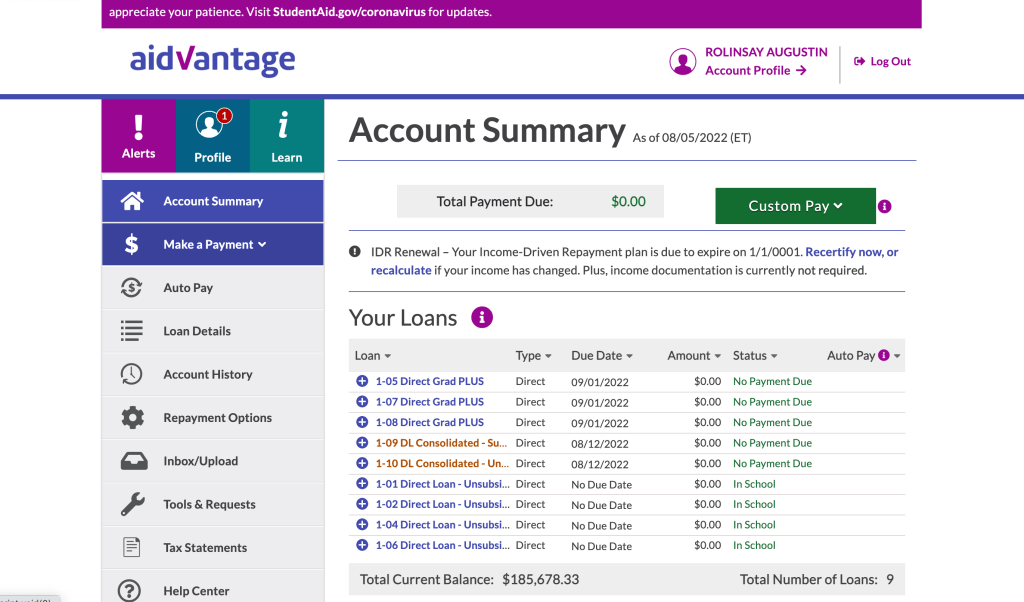
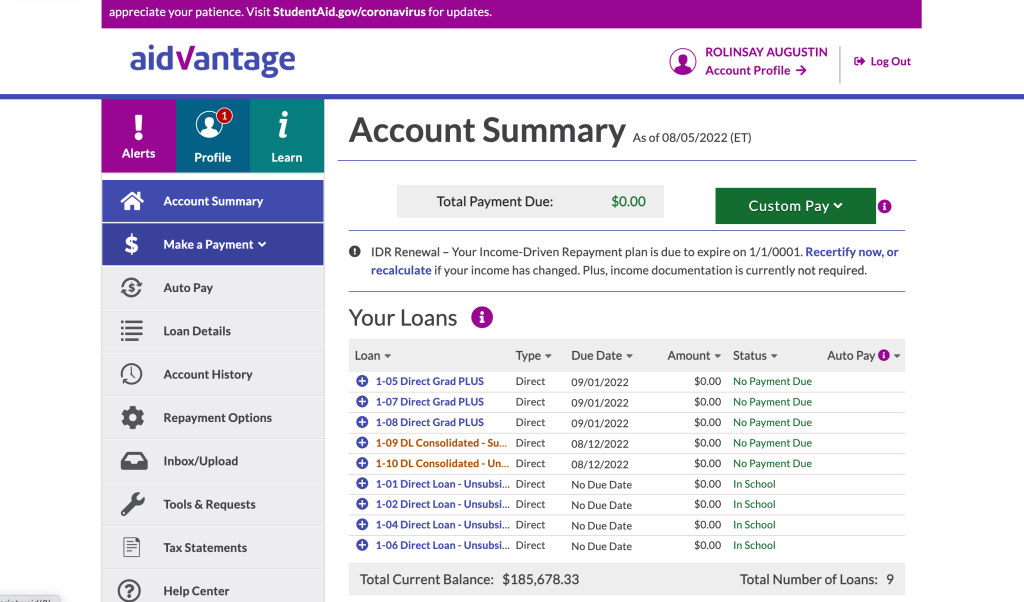
Recap of my last post: Federal student loan balance as of August 2022.
If you haven’t read it yet, check out my previous post, “How I Paid Off $100K of My $287K Student Loans in 12 Months,”where I detailed my loan repayment strategy. Back in August 2022, I shared this picture showing my federal student loan balance at $185,678.33—a significant milestone after paying off $100K of my original $287,345 balance.
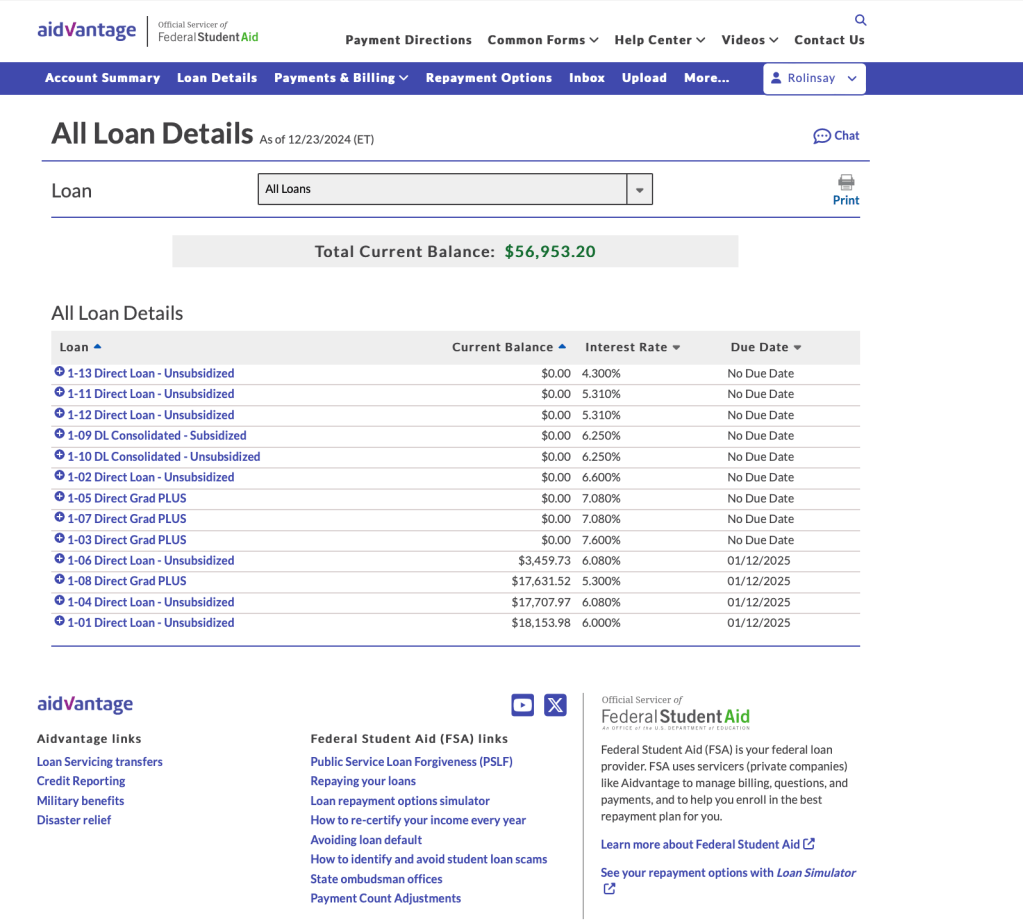
Well, today I am proud to say that I have stuck to the plan (well kinda). After my graduation in May 2021, I started with a total federal student loan balance of $287,345. I did say that I would pay it off in 36 months which would have been August 2024. I fell short since 40 months later (December 2024) I still have a balance of $56,953. However, I am super proud of how much I have paid off.
I totally underestimated interests, and really, life in general.
Let me explain
Credit Cards
I paid off 10K in credit card debts. I used to have 14 credit cards, but now I’ve streamlined to just three: Apple, Capital One, and Chase. I came to realize that having so many credit cards was disrupting my financial plans and goals. Honestly, who needs 14 credit cards, let alone the time to manage them all? Now, I no longer carry a balance and rarely use my credit cards—only for significant purchases where earning 2% cash back might save me around $20 on weekly hospital cafeteria expenses.
Back Taxes
Here’s a big one: Between 2014 and 2020, I accumulated back taxes that kept growing with interest over the years. By the time I graduated from CRNA school in 2021, my balance with the IRS had ballooned to a staggering $50,000—ouch. Everyone I consulted strongly advised me to pay it off as quickly as possible, so I did. I tackled the entire $50K, and I’m proud to say I now have a $0 balance with the IRS. Moving forward, I fully intend to keep it that way!
GOT MARRIED !!!
Here’s another big update—I tied the knot! And let me tell you, it wasn’t cheap. As you may remember, my fiancé (now husband) is also a CRNA. I’d always dreamed of a grand wedding: stunning real flowers, designer shoes, a show-stopping dress—you can probably see where this is headed. The price tag? A whopping $110K for an unforgettable celebration at The Palace in Somerset, NJ. It was an absolutely beautiful day, one I wish I could relive over and over.
While $110K vanished in just one night, we did receive $40K in monetary gifts from our guests. We had requested cash gifts instead of a traditional registry since we didn’t own a home at the time. It was a day to remember, and every penny was worth it!
LAST UPDATE
I went from Full time W-2 CRNA to 1099 Locum Tenens CRNA. Oh yeah, it was a big deal. I will have an entire post about it and how good and messy it can be so stay tuned.
Here’s my CURRENT LOAN BALANCE updated sheet
I used the avalanche method to pay off my loans (pay the loans with highest interest first). I am anticipating finishing paying off my $56K balance by March 2025, fingers crossed.
I hope this can somehow motivate you to go to school and not worry about the big loan balance that comes with CRNA school. Tip: Last year I, alone, also made $357K. If you stay organize , and don’t have a lavish unnecessary wedding, 36 months is more than enough time to pay off all your loans.
So to summarize here’s all I’ve paid:
Loans 129K
Credit Cards $10K
Back taxes $50K
Wedding $40K (my contribution)
That’s a whopping $100K that could have gone toward my student loans. However, I do believe those expenses were necessary. Recently, I started listening to The Ramsey Show podcast, and it’s been an eye-opener in helping me redefine my financial goals. I’m thrilled to be making significant progress in eliminating my debts with relentless determination!
If you’ve been reading my posts, you’d already know that I graduated from CRNA school with a large amount of student debt: $287,345 to be exact. Most CRNAs in my class graduated with an average of 175-200K in student debt. If you haven’t been reading my post, you should know that the loan amount include some undergraduate loans, nurse practitioner school tuition, CRNA school tuition/ living expenses. My first payment on my loans was made on August 11th, 2021 and today, as of August 6th, 2022 , I have paid a total of $101,666 bringing my balance down to $185,678.33. If you want to read my initial blog about my post click here
How did I manage to pay that much in exactly 12 months, here’s how:
Current balance snapshot
CREATE A SPREADSHEET (preferably before you first paycheck)
I first created a one-page 36-month spreadsheet to see if the goal was feasible first. I created the spreadsheet before my first paycheck arrived in the bank account. The spreadsheet kept me organized and excited because you get to see the loan amount go down every two weeks. I look at the spreadsheet almost every other day to maintain a laser vision of how much I wanted to pay down for that particular month.
2. MAKE A PAYMENT EVERY PAYCHECK
I get paid biweekly so I make payments every two weeks. I schedule the payments the day before the paycheck arrives in my bank account. For example, I get paid every other Friday but I scheduled the loan payment for every other Thursday. By Friday morning the payment is already deducted from my account right after my paycheck is deposited. The purpose is to not spend the money on other things. So, I don’t give myself the options of lowering the scheduled monthly payment amount to pay other stuff, like bills. I paid on average $8500 a month making two $4000 payments every month. I make about 10K a month (net income after pre and post tax 401, insurance etc), leaving 2K /month for other expenses like school (getting my DNAP)
3. PAY DOWN HIGH INTEREST LOAN FIRST- Held off refinancing (Biden’s interest pause)
All my loans are federal loans. I paid down one out of the 10-12 loans with the highest interest rate of 7%. All my other loans were about 6%, 6.1% 6.3% etc. I did not refinance my loans because once you refinance with a private lender, you will not qualify for any federal loan forgiveness or interest rate pause. As we are still awaiting on Biden to make a decision on the student loan repayment pause, I will not be refinancing my loans at this time.
4. GET A SECOND JOB/ WORK EXTRA SHIFTS
This one is tough. You have to be highly motivated with a high desire to get out of debt quick and live your best life. At my job I get six paid vacation weeks. I scheduled my six vacation weeks during winter time and boring weeks of the year, basically when most people do not take their vacation. When more people are working, there are less chance of overtime because we are well-staffed. But in prime time, where the hospital is very busy, I work every day they would let me. This past spring and summer, I worked about 64 hours a week, almost every week, that’s 24 hours of overtime which is paid time and a half.
I did get a second job too. I know, crazy right. I work per diem at another hospital. The pay is great because they pay you to be on call at home and even if you don’t get called in you still get paid 1K, but if you do get called in, it’s 1K + whatever hours you work * 140. That’s pretty awesome right.
5. LIVE OFF YOUR BOYFRIEND/SPOUSE/ FIANCE / PARENTS 90% of my paycheck goes to my loans. I didn’t buy a fancy car, house, etc. because I knew I wanted to get rid of my student loans first. My fiance pays for literally everything: rent, food, utilities, gas, vacation, etc. I pay for a few things here and there but he is mainly the person spending. He is happy to help me get the debt down but I am grateful that he does and I make sure I make him feel appreciated every time I make a payment. I promised him I will pay the first two years of our mortgage alone as my pay back.
In conclusion, if paying down your loans doesn’t feel dumb, annoying, painful sometimes, you are not doing it right. It requires a lot of sacrifices, from you and your family. I am hoping to be down to 130K by the end of this year. I will keep you all posted.
Did you guys hear the good news? Biden extended pause on student loan repayment through May 1. This is great news and probably a good Christmas present for every single student with federal loans. Interest accruals are also on pause. For someone with high federal loans, it means in the next few months I will save thousands of dollars. Like some of you may already know, I have been paying my loans aggressively. Matter of fact, I was about one week away from signing my loan refinance papers either with Earnest or Laurel Road refinance companies. My current interest rate with my federal loans is 6.5% and I got approved with both Earnest and Laurel Road with 3.2% and 2.66%, respectively. Obviously, I would have signed up with Laurel road. But first, you may be wondering, how is the new job going?
It’s been 6 months already since I started working as a CRNA, unbelievable. My boyfriend and I work the same place, same company, same shift. We help each other out every day, and it makes a huge difference at work to have a work buddy/boyfriend. I’ve done some pretty intense cases on my own already such as lung, heads and backs. This is the best career, no doubt! I love my job. It’s a plus for a quiet, introverted person like me, behind the blue drape, away from the chatter. I do chime in once in a while, but not a lot. What can I say, I am a quiet girl! The staff nurses are respectful and good, they do their jobs well and that’s what matters to me.
As far as loan repayment, I am not doing as well as I thought I’d be doing with paying it off. The reason is because my sister and I teamed up to buy a single family house for our parents. Between closing costs, down payment and renovation costs, I spent about 25K. I am still on track to pay all my loans off by Jan-Feb 2024. I went from a starting balance of 287,345 to $251,500 in about 5 months, averaging about $7000/month payment. I stare at my loan repayment spreadsheet every day, sometimes multiple times a day. It hurst more than it helps, lol but it keeps me motivated. If I didn’t buy a house for my parents, I’d be down to $225K. However, paying down my loans doesn’t make me half as happy as seeing my parents live in a better place, a place they can call their own home. My parents came here as immigrants from Haiti and worked hard to ensure that myself and my siblings have an opportunity to succeed. What a way to pay them back for their sacrifices!
That’s it for update.
Have a good day everyone!
Study hard if you’re in CRNA school
Never give up if you’re trying to get into CRNA school
Pay those loans off if you’re a CRNA with loans
Enjoy life and live debt free if you’re a CRNA with no loans.
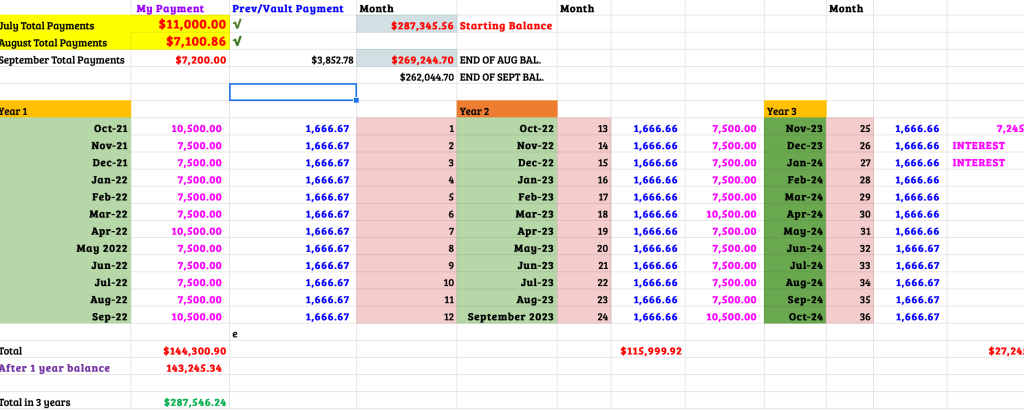
I am a HUGE fan of spreadsheet AND I’m pretty much cheap (till I get these student loans paid off). This is the exactly the spreadsheet that I have made and plan on using for my loan repayment plan. As you can see, I have made 2 payments, totaling $18,100 since I started my job as a CRNA in July (I paid off all my credit cards debts too). The last post I made, I stated that I was planning on paying off all my student loans in 36 months. However, there is a possibility that I may pay them off in about 24-25 months.
Looking at the spreadsheet, blue payments ($1666.67), and they are the payments scheduled to be made by my employer as part of their loan repayment program starting October 2021 (3 months). They will pay a total of $60,000 over 36 months. I will pay my share of the payments in about 25 months and the only payments remaining will be my employer’s payments. I am hopeful that I can stick to my payment plan and continue to cut my expenses. My next payment is scheduled for 9/2/2021 for $3800s. I will keep you all posted.
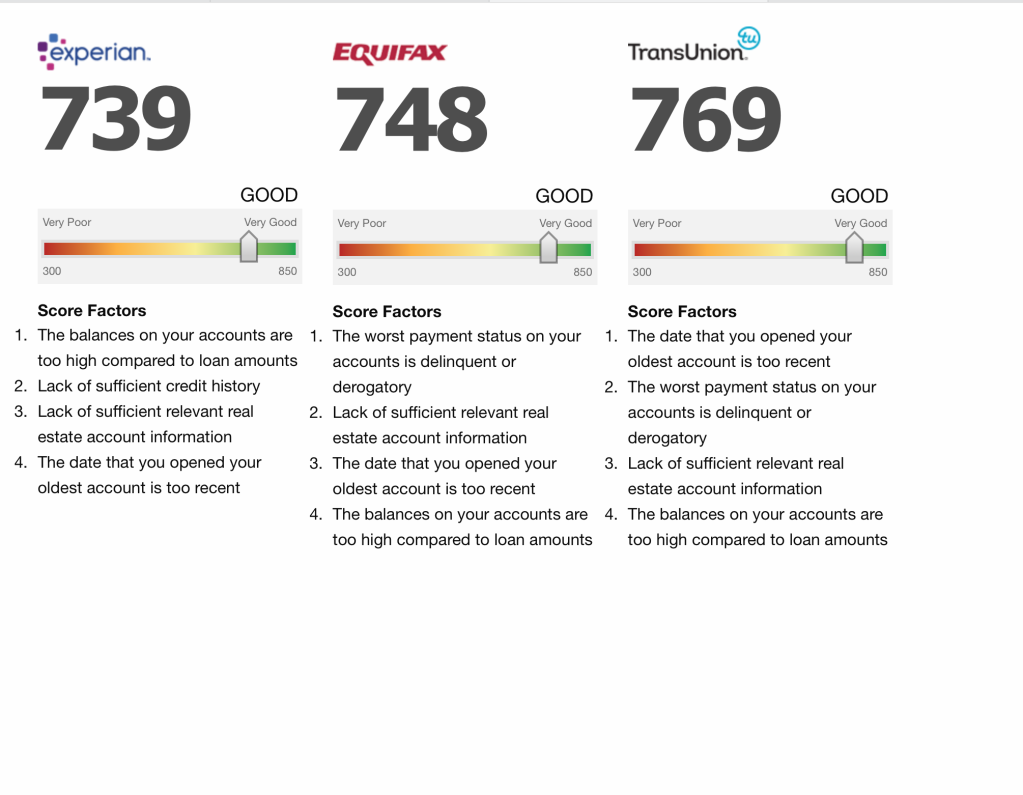
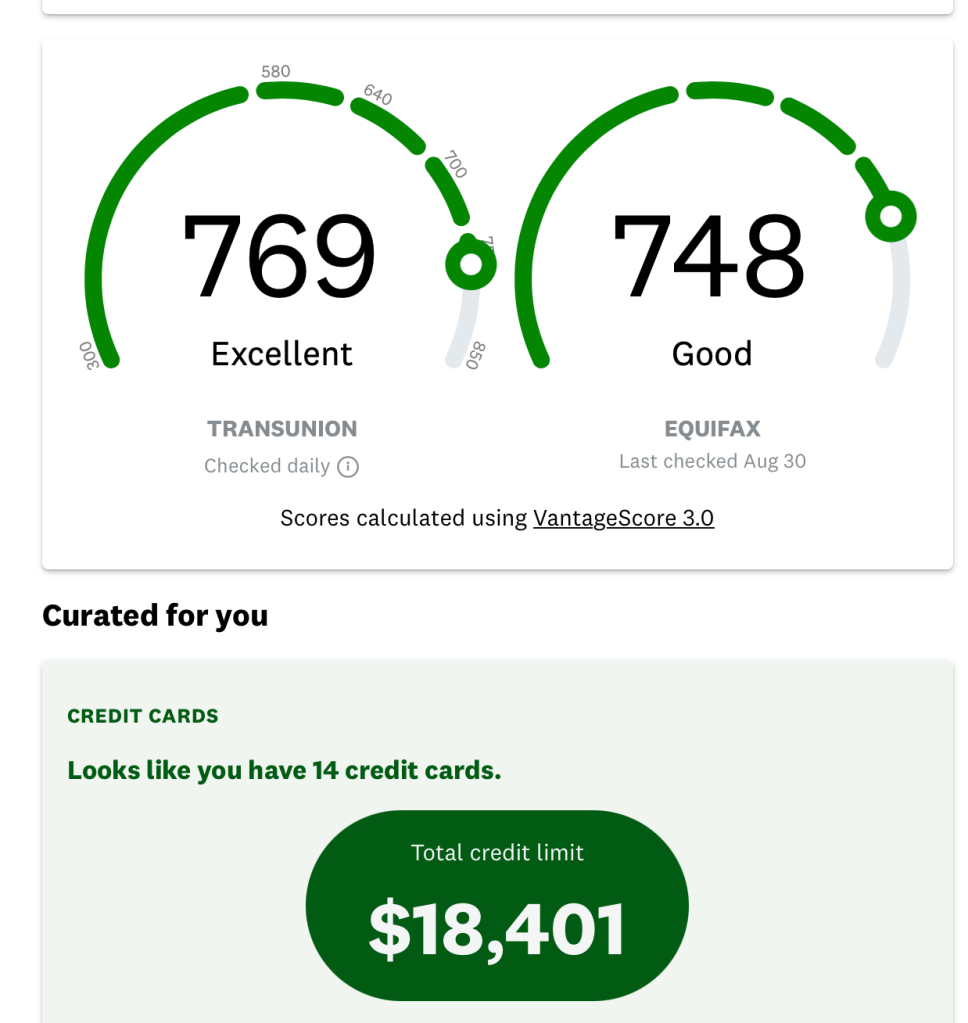
Even Better news –> my credit scores went up after I paid off two of my student loans and all my credit cards debts (my credit utilization went from 56% to 3% . I use to be in the 690s (fair), after I paid off two of my loans, my credit scores jumped to : (see pic below)
My credit Scores as of 8/30/21
I did not want to spend money. So I obtained the above copy of my credit scores from credit sesame. They offer a 7-day free trial when you sign up for sesame premium. I plan on canceling it on the 5th or 6th day. I really don’t want to pay any money on credit companies. I only went on credit sesame premium because I doubted my free creditKarma scores (initially). I just couldn’t believe that my scores went up. But, as you can seen, my scores below from credit KARMA and those up there from credit sesame premium were exactly the same. So, stick to the free credit karma (or free version of credit sesame).
MY next post I will talk about my plan about reducing the number of credit cards I currently have (14 credit cards). Major ones includes Apple Card, Chase, Discover, and Capital one.
Hi all, how’s your journey to CRNA school going? Just wanted to share my current plan as far as loan repayment goes.
Yes, $287,345 is my current federal student loan balance. Just a reminder: That amount include some undergraduate loans (about $50K), my NP loans and CRNA school loans. Yeah, wish me luck.
My plan is to pay off my loans in OR before exactly 36 months (3 years) from July 2021. And yes, today I just made my first payment of $11K. How ? well, I signed up with an anesthesia group and they offered a sign-on bonus (40K–> way less after tax) as well as a tuition reimbursement. The tuition reimbursement amount offered by my employer is 60K. Therefore, I really have to pay a total of $227,245 in 36 months. I am super excited to pay it back? Why? Because I am a CRNA today because federal loans were made available to me. Therefore, I am super grateful to have loans… Sounds silly? yeah I know. Today I was able to use my sign-on bonus to pay off all my CREDIT CARDS ($14,000, whew, I don’t know how I racked up so much debt during school) and ALSO I made my initial payment of $11,000 today. I paid 1 out of 14 loans, it feels great 🙂 Therefore, my balance now is $276,345 minus the 60K from my employer = $216,345. For the next 36 months, I have to pay $6000 a month. Given my monthly income of $9000 ish. I am hoping I can stay disciplined enough to make it happen.
That first payment hurts!!! As much as I want to be financially independent, I gotta admit, I love to splurge. I drive a 2010 Nissan Maxima and I am hopeful that it’ll last another 36 months. Yeah, I am tempted to drive a 2021 Porsche, or TESLA… However, I will not buy a new car. I canceled my Netflix, Hulu, and all other unnecessary subscriptions. I have $5000 for an emergency funds, contribute 9% of my salary in my 401K.
I am hoping this goal is achievable.
Are you paying off your loans in an effort to achieve financial freedom?
Are you applying for HRSA loan repayment (I don’t qualify since I work for an anesthesia group and they are “for profit”)?
There are many myths about the CRNA job/career that I often heard before attending CRNA school. I will discuss them here on this post.
CRNA don’t really make moremoney: actually job offers for CRNA around the Northeast region range from high 180K to low 200s plus sign-on bonuses ranging from 30-50K. The highest CRNA position salary can be as high as 280K if you’re willing to start independently (1099 not W-2). In addition to sign-on bonuses, many other employers offer tuition reimbursement, paid directly to the loan servicer, ranging from 10K to 100K.
Malpractice insurance is expensive, making CRNA school not worth it: Many employers pay for your malpractice insurance and it’s really up to you if you want additional coverage. As far as I know , most employers (anesthesia group) cover and provide malpractice insurance for the group.
You now need a doctorate to practice anesthesia: The move to a doctorate for entry to practice is scheduled for 2025.If you can manage to get admitted within the next 4 years (I’m writing this post as of 2021), you will be grandfathered in and will not be required to obtain a DNAP to practice
CRNA school is TOO hard: My undergrad GPA was 3.25 with a science GPA of about 3.2. I took some graduate school courses and obtain an NP degree before CRNA school. However, CRNA school is not really like NP school. All you need is the ability to study hard for your CCRN. If you can obtain your CCRN and have 1-2 years of ICU experience, plus a GPA > 3.0 you have a chance, just keep applying. Once you’re admitted, you need to change your study strategy tremendously. Getting into CRNA school, is just the beginning. For me , I started doing electronic flashcards on brains cape (created my own flashcards) that’s what worked for me. Find what works for you and be honest with yourself. I graduated with a 3.9 GPA and took my NBCRNA boards 1 day after my completion date. I struggled with undergrad nursing initially. My point is CRNA school is doable, you just need a lot of discipline and consistency.
Apply only to top reputable schools: Know that the best program is the program that accepts you! don’t get carried away trying to apply to top schools, we all will apply for the same CRNA positions and have the same title. The only difference between CRNAs who attended a top CRNA school and the CRNA who went to some unrated CRNA school is that the one who attented a top CRNA School will probably have way more loans to pay back. School is what you make it. The CRNA instructors are unable to make you a good practitioner. You have to make yourself a good practitioner to get and maintain your CRNA license.
In conclusion, there are many myths out there about the CRNA profession. Make your own research, ask a CRNA, shadow one if you’re unsure about what the job entails. I’m a newer CRNA and I am able to honestly answer any questions you may have. The decision to become a CRNA is the best decision I’ve ever made. Believe in yourself.
You have finally made the decision to apply to CRNA school after you have successfully met all the general admission criteria. You’re probably wondering where to start and how to find the CRNA schools that meet “your” criteria. Hopefully this post will give you some ideas about how to find a good school and where to start with your search.
SEARCHING…
My mentor, David,CRNA, told me once ” the best school is the school that accepts you”. However, let’s say you are a very strong applicant and you get accepted to three schools, then what do you do? How do you rank all three of them properly? The first step in applying to CRNA school is to establish your own criteria. Here are some factors you might want to consider:
MSN vs DNAP : If you haven’t already done so by now, by the time you apply to CRNA school, most programs will be at least 36 months in length and a Doctorate’s program. As of July 2019, there is only 36 out 118 schools still offering an MSN program and most are planning on starting their 1st DNP Cohort between January next year and September 2020. After those dates, only about 2-3 schools will still offer an MSN, since their first DNP cohort will start in 2022.
Experience: This is straight forward, if you have 1 year of experience in ICU, DO NOT apply to schools requiring 2 years of experience. Chances are that you will not be as competitive as other applicants. Filter your search, and pick only schools accepting just 1 year of experience. As of July 2019, 122/138 schools require 1 year of experience, so, you are in good shape even with 1 year of experience.
Cost (if you care): Programs cost range from$0 (army CRNA programs) to 211K (UPenn). You’ll have to find out the schools you want to apply to and their tuition costs. Regardless, unless you have thousands saved, you will probably pay for your school expenses and living expenses with both Sub and Unsubsidized loans, in some cases, you may have to take out Graduate PLUS loan. I’d stay away from private loans, they tend to have higher interest rates.
State: In-state vs. Out-of-state. I do not do well with cold weather, therefore, schools in cold states were filtered out. I’m currently in CRNA school in Florida 😉 However, you might like cold weather, maybe you like to ski or snow in general. Regardless, know where exactly you want to be and do not waste your time applying to places you know you wouldn’t enjoy.
FAMILY: If you have a family, you do have an extra step to find out what would be the best for your family. Expect the first 3-4 semesters to be really tough as you will have a lot of reading assignments, exams and quizzes back to back. If you’re staying or moving with your family, have a serious conversation about the high expectations. You want to start out with a strong foundation of the basic sciences.
APPLYING..
To apply, you will need to spend a lot of time researching and looking into the admission criteria and process of each school. How many schools you apply to DEPENDS ON YOU and how competitive of an applicant you are. Be honest with yourself and save your money.
How many schools to apply for: ( you may apply to less school if you have confident that you are overqualified based on their criteria)
Apply to <5 Schools if you are very competitive : GPA >3.8, Excellent GRE scores ( or you scored well above the score required) , Analytical >4, CCRN, No Cs on your undergraduate school transcripts and 2+ ICU experience and good letters from you superiors.
5-10 Schools if you are competitive: GPA >3.5 less than 3.7, Good GRE scores (or you scored the score required) , CCRN, Analytical 3.5 -4, No Cs on your undergraduate school transcripts and 2+ ICU experience and good letters from you superiors.
10-20 Schools if you are less competitive: GPA 3.3-3.5 ok GRE scores (or you scored close to the score required) , Analytical 3.5 -4, No 1-2 Cs on your undergraduate school transcripts and 1+ ICU experience
As many schools as you can if your GPA is less than 3.1. Compensate by having more years of experience, and take some graduate courses or retake undergrad courses ( I would recommend A&P I and II or Chem) to boost your GPA up. Make sure you take one course at a time to increase your chance of getting an A.
GOOD RESOURCES
allcrnaschools.com . This is the best resource as far as I know. It saves you a lot of time by listing schools by state, costs and other criteria. I personally used that resource and HIGHLY recommend it.
School websites. If you already have a few schools in mind, print their application requirements and highlights all of the requirements. If you do have questions, do not hesitate to email the program director, be very professional in your email, and do not ask questions about criteria already listed on their websites.
Allnurses.com. Best resource to speak with current students who are also applying and connect with them. It’ll also help you find out how competitive you are vs other applicants. If you cannot find the thread, start one! When I went on to allnurses.com and looked for keiser applicants I only found old threads, I read some of them but them I created a thread “Keiser (Wolford) 2019 Applicants”, and within a few days, I connected with many other applicants. The thread is actually still active and new applicants are still using it to connect with other applicants. They share stuff like interview dates, questions, acceptance letters, etc. Check them out.
Be Organized; Have a folder for each school you are applying to and every correspondence you have received from them. Have contact numbers and emails just in case you have questions. Being organized, it will save you time and energy.
Those are the resources that I found most useful when I was searching and applying for CRNA schools. I hope you find them helpful as well. Any questions or concerns, drop a comment!
Congratulations! I assume that you’ve completed about 1750 hours in the ICU or have worked there for at least a year/ or you’re getting close to a year, that is great news. Hopefully you have been reading and learning about vasopressors, cardiac and respiratory problems and some methods of hemodynamics monitoring, however if you haven’t, no worries. I will recommend some great resources that will help you study and pass your CCRN exam on first try.
Why is CCRN important for CRNA school?
Most schools require applicants to be CCRN certified. CCRN not only makes you a competitive candidate but it also shows your dedication to attend CRNA school. The CCRN is hard, but, only if you’re not well prepared. You can definitely pass on your first try. CCRN shows your ability to critically think. You’ve probably worked with some ICU nurses who knew “what” works but not necessarily how it works. Well, the CCRN just kinda show the admission committees that you went above and beyond to show your ability to think critically and provide the best, safest care for your patients. Can you get into CRNA school without the CCRN, absolutely. If you have a high undergrad GPA (i.e 3.7 or above), have 3+ years of experience in a large ICU, and scored well on a GRE, and leadership loves you, well, you may be able to skip the CCRN and still get admitted, as long as CCRN certification is not a minimum requirements of the school. Otherwise, I would recommend you take and pass the CCRN before applying to CRNA school. You don’t want to waste time and spend your money applying to schools and not be certain and sure that you are a competitive applicant.
CCRN Requirements, Fees and Blueprint
To be eligible to take the CCRN you must:
be a licensed RN or APRN
Have completed 1750 hours in direct care of acutely/critically ill patients ( orientation/ shadowing does not count)
Be able to provide a colleague information who can verify that you have completed 1750 hours in the ICU (can be a fellow RN or anyone at work really)
Pay the $344 fee
The CCRN blueprint/ Test plan is posted on the AACN website and this is a brief breakdown of it:
The test plan have a detailed list of topics you should review for each section mentioned above. Now, with that said, when was the last time you fail a test when the teacher gave you a clear and detailed study guide? Hopefully, never, or at least, you know you did not pass cause you did not study. Well, let’s talk about some good resources that I did find very helpful.
RESOURCES to study for CCRN: what’s helpful
There are hundreds of resources to help you prepare for the CCRN, but let me tell you which ones worked for me:
ECCO Modules: Like I mentioned in my other blog, this is a resource that is often overlooked. The AACN prepared those modules and the information is succinct and clear. I took notes while doing my ECCO modules during my ICU orientation and they were honestly the most helpful in preparing me for the CCRN. Check with your ICU educator to see whether or not you can be given brief access to them If you hospital uses them for ICU orientation, if not, then step 2
PASS CCRN Book by Dennison. I have completed many questions from that book and they were very helpful to me. You don’t have to buy the book to get access to the Q+A . Just buy online access through any websites. Best way to USE: After answering the question, read the rationales (whether you got it right or wrong), take notes from the rationales and move on to the next questions
AACN CCRN preparation modules : I did NOT personally use that resource. Although some colleagues said they were helpful, to what extent? I am not sure. Therefore, Not really recommending those, just letting you know that they are available
BRAINSCAPE.COM : I continue to use this website as an SRNA. Brainscape.com is a website that allows you to create your own flashcard sets and study them. Now, Quizlet you may be familiar with, but brainscape is much better because it tells you how well you have mastered the material by showing a % at the end of each study session. Best way to use: Those notes that you take when you’re doing questions from the rationales, create your OWN flashcards with them. Another easier way is to copy and paste your notes to flashcards as you’re studying and doing questions. Create your flashcards by topics, i.e cardiac, pulmonary, etc. ( I would also recommend studying by topics). Then, make sure you master each flashcards set to at least 85% before you take the CCRN. I guarantee you’ll pass first try.
Watch youtube videos about topics or concepts you don’t understand. Youtube is a very good resource that you will most likely use for CRNA school as well. Why not use to prepare for CCRN. There are many videos that can help you fully grasp hard concepts. Also, drnajeeblectures.com is also a good resource. His websites have many videos about concepts and although they are made for medical students, they are plain and simple and easy to understand. He does have a little Indian accent but he’s smart and understandable. I would highly recommend for CRNA school as well.
As always, I hope someone somewhere can benefit from this blog! Any questions or comments, Feel free to comment/ contact me.
If you’re currently a med-surg nurse and you’re interested in applying to CRNA school within the next 5 years, I have a few advice for you to help you plan accordingly.
Med-Surg EXPERIENCE is good...
Although CRNA schools require ICU experience, it is recommended to have some med-surg experience as it will help you become a well-rounded nurse. Med-surg nursing provides a good knowledge foundation for ICU positions. In fact, most ICU nurses have at least one year of nursing experience working in ER, PACU or other med-surg units. Ok, now what?
WHICH ICU?
If your goal is to start CRNA school within the next 5 years, then now is a good time to start thinking about getting an ICU position. You want to work on a general ICU, Medical ICU or Surgical ICU. Those units will help you pass CCRN because you will be familiar with most of the disease processes that you will be tested on. Neuro ICU and Pediatric ICU are also accepted by most CRNA schools. If you want to be competitive, here are the list of ICU floors you want to work on , from most desirable to least desirable: Cardio-thoracic (CT) ICU –>Surgical ICU–> Medical ICU–> General ICU –> Neuro ICU –> NICU –> Pediatric ICU. Working in CTICU, SICU and MICU, you will become familiar with vasoactive drips and advanced hemodynamic monitoring. Also, you will interact with the surgical teams and will most likely care for post-cardiac surgeries, PE, sepsis, trauma injury patients, etc.
THINGS I CAN DO now ?
Few things that you can do at work to improve your nursing skills and acquire more nursing knowledge include reading doctors’ notes, relate medications with the patient’s current medical diagnoses, read, read and read. Get into the habit of asking questions to anyone willing to answer and improve your knowledge. For example, why are some specific beta blockers ok to be given to asthmatic patients and others are not? Practice clinical thinking skills by ordering a med-surg certification book with questions and answers, buy a used one. your goal is to get into the habit of critical thinking and increasing your knowledge. I’m NOT really recommending taking the med-surg certification because I don’t believe it’ll make you a more competitive candidate. But that’s just my opinion. LAST but not least, take a non-degree graduate course, if you have time. Most companies nowadays offer TUITION reimbursement. If your company does, sign-up for an online graduate CHEAP course that you will be fully reimbursed for. THERE are MANY schools online which allows you to take advance courses. CRNA school is a major investment, a good one though. You want to make sure you’re comfortable taking grad level courses , or if you’re not, at least you’ll know what to expect and what to work on in the meantime.
LIFE and things
Start getting rid of unnecessary bills such as card and credit card payments. Pay off your car, furnitures or other financial obligations. You will most likely take out federal student loans while in school, unless you can save a good $70,000 to pay the school cash and another $40,000 for living expenses (If you plan on living alone and on a tight budget). That alone adds up to 110K which is not realistic, unless you got it like that lol. Anyway, cheaper schools are more competitive and your chances of getting in are slimmer if you’re not a strong candidate (high GPA, 5+ ICU, High GRE, good letters etc.) The best choice would be a moderately expensive school. I will talk about schools and choices in a later post.
If you’re planning on getting married within the next 5 years, do so sooner rather than later. However, know that CRNA school can either strengthen or weaken your relationship with your partner. It all depends on how strong your relationship foundation is. I hate to say this but wives are usually a little more supportive than husbands. Successful students usually stay pass their scheduled times in the Operating room, but generally not a requirement per se. Expect to spend long hours in the OR. If you have smaller children, make sure you have a strong support system such as close relatives, parents or friends. You will need it on days that your OR case doesn’t go as planned or when you’re running late and need someone to pick them up from school.
CONCLUSION
As a med-surg nurse you are at an advantage. You have time to plan, plan and plan accordingly. From picking out the right ICU to saving and getting financially ready, you will be on the right path to success. You can start looking into schools and states that you want to consider but it’s a little early to do so. REMEMBER also that, by the time you apply, all CRNA programs will be at least 36 months in length.


 Student Registered Nurse Anesthetist